War of 1971
1971 War
Sajad Haider's primary role during the 1971 War was the Officer Commanding (OC) Flying Wing at Sargodha (No 33 Wing), a position he took in mid-September. He immediately focused on operational readiness but lamented the loss of the classical pre-emption opportunity because the political leadership delayed launching a counter-air and land assault after the Indian Army invaded East Pakistan. When the war officially began on December 3rd, the first Mirage strike against Pathankot missed its target, hampered by darkness and timing issues. His F-6 Squadrons provided constant Close Air Support, using their 30 mm guns effectively against Indian armour, particularly in the critical Shakargarh and Sialkot sectors. The conflict concluded abruptly for him when a crucial Mirage bombing mission he was escorting against the Ferozpur marshalling yard on December 17th was falsely recalled by a senior staff officer, wasting a strategic opportunity and severely demoralising his crews
Air Battle over Dhaka
In East Pakistan (Bangladesh), the solitary No. 14 Squadron ("Tail-Choppers") faced overwhelming odds, pitted against ten Indian Air Force (IAF) squadrons due to operational mismanagement and internal politics. Operating from the single runway at Tejgaon, they maintained Combat Air Patrols (CAPs) from dawn to dusk in a struggle Haider compared to the Battle of Britain, but by the end of 7 December, Indian MiG-21s effectively halved the Tejgaon runway with precision bombing, finally grounding the squadron’s remaining 11 aircraft.
Interdictions on the Western Front
On the Western Front, the PAF launched a series of strikes on 3 December targeting Indian airfields like Amritsar, Pathankot, and Srinagar. Unlike 1965, the focus was on cratering runways because the IAF had moved their aircraft into hardened concrete shelters, and while Sajad did not fly the mission himself (as much as he wanted to relive his memories of 1965), he was persuaded to stay behind by Wg Cdr Hakimullah to supervise the conduct of operations. Hakimullah led a particularly successful Mirage mission that decimated a large assembly of Indian tanks at the Mukerian railway station. However, the campaign also saw the loss of the legendary Wg Cdr Mervyn Middlecoat, who was shot down in his F-104 by a MiG-21 on 12 December.
Defence of Sialkot
As Officer Commanding (OC) No. 33 Flying Wing at Sargodha, Sajad Haider defended the Shakargarh and Sialkot sectors during the 1971 War. Under his leadership, the wing launched between 50 and 80 missions daily into the intense tank battles at Phillora and Chawinda, where Sajad mandated the use of 1,000 lb bombs to halt Indian armoured thrusts. Sajad did not merely command from the ground; he personally flew 20 operational missions during the conflict, including a notable sortie on 13 December in the Shakargarh salient. During that mission, after witnessing his wingman, Flt Lt Cecil Chaudhry, bail out behind enemy lines, Sajad conducted aggressive strafing runs to deter Indian soldiers and provide cover until Chaudhry could be reached by Pakistani troops. Sajad’s wing was celebrated by the Army’s Chief of General Staff, Lt Gen Gul Hassan, for its spectacular performance in saving Sialkot
Sajad Haider’s Combat and the Ferozpur Incident
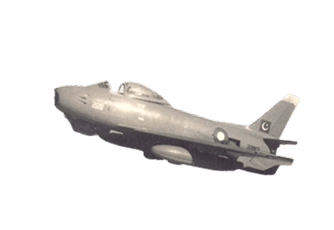
Sajad Haider personally flew 20 operational missions during the conflict. On 13 December, while flying a Mirage-IIIE, he engaged in a high-speed chase of two Indian Su-7s near Shakargarh. Due to a weapon switching error and the low altitude of the bandits, his missiles failed to lock, and he narrowly avoided overflying Pathankot airfield while exiting the combat zone with critically low fuel. On 17 December, Sajad prepared a strike of 4 Mirages to bomb the Ferozpur marshalling yard. Moments before the attack, Air Vice Mshl Saeedullah Khan ordered a recall over the radio, falsely claiming it was the Air Chief's instruction. This botched command, which confused a sector-specific dust haze with the target area, caused the mission to be aborted.